Disclosure: This post contains affiliate links. If you book through them, I may earn a commission at no extra cost to you.
Your first cold sweat in Korea
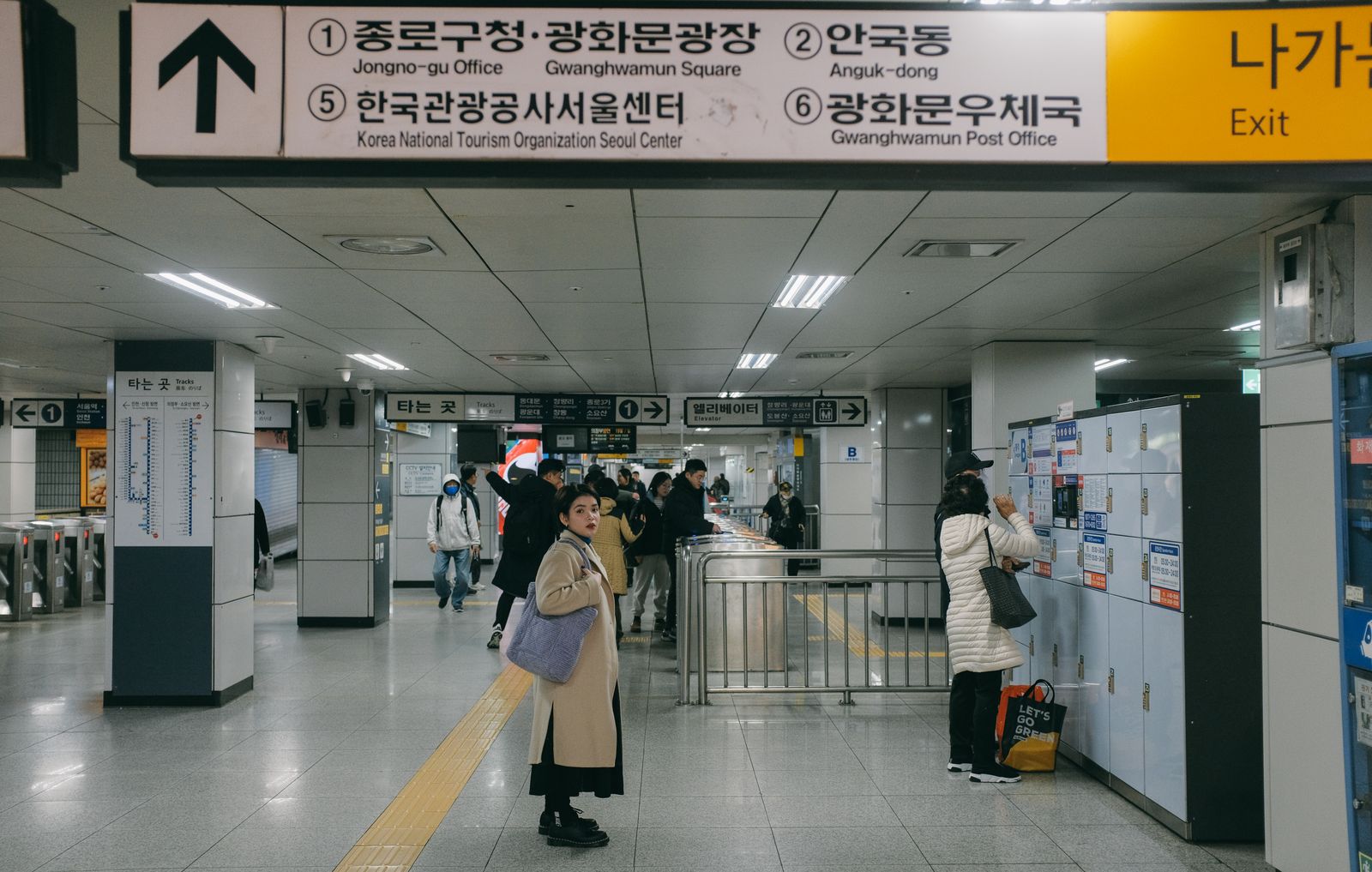
It usually hits at a subway gate.
You tap the card that works fine everywhere back home. Beep. The gate stays shut. The line behind you grows. You tap again. Beep.
Korea is almost entirely cashless — cafés, taxis, convenience stores, one tap and done. And yet your card is the one that keeps getting turned away. It’s not you. The system was built for locals, and visitors fall through the cracks.
The fix is simpler than the problem: one card. The catch is that the right Korea travel card is different for different people. The four that matter — T-money, WOWPASS, the Climate Card and digital T-money — and you really only need one. No spec sheets, no another how to pay in Korea explainer. Tell me what kind of traveler you are, and I’ll point you to yours.
The 30-second answer: which Korea travel card to get
| If this is you… | Get… |
|---|---|
| You hate fuss and you’re here for a few days | 🎫 T-money |
| You want one card for transit, shopping and currency exchange (especially first-timers) | 💳 WOWPASS |
| You live on your iPhone and travel light | 📱 Digital T-money iPhone |
| You’re mostly in Seoul and ride transit all day | 🚇 Climate Card Tourist Pass |
Skip to your type below — or read all four, your call.
Why your foreign card gets declined in Korea
Three things, and then it all makes sense.
- The subway gate. Korean transit runs on prepaid tap cards (like T-money). Tapping a contactless card from back home straight on the gate — “open-loop” — isn’t a thing here yet (Seoul starts rolling it out in 2027, fully by 2030). So you need a transit card, full stop.
- Small shops, street stalls, traditional markets. Foreign cards carry high fees, so plenty of small vendors simply don’t take them. Cash wins here.
- Local pay apps (Naver Pay, Kakao Pay, Toss). Every Korean lives on them — and almost no short-term visitor can use them, because they need a Korean bank account and ID verification.
Good news: one card plus a little cash covers all three. Your turn.
① “Keep it simple, short trip” → T-money
You’d rather not think about it, and you’re in and out in a few days. Then don’t overthink it — get a T-money card. It’s the plain, reliable workhorse of Korean transit: nothing flashy, works everywhere, never lets you down.

- Where to buy: any convenience store (CU, GS25, 7-Eleven, Emart24, Ministop), subway vending machines, or the minute you land (convenience stores in arrivals, the AREX travel center). The card runs about ₩2,500.
- Where it works: subway, bus and taxi nationwide — plus convenience-store purchases.
Topping it up (cash):
- At a convenience store: hand the cashier your card and say “Top up my T-money, please.” (in Korean: Ti-meo-ni chung-jeon-hae ju-se-yo). Tell them the amount or just show the cash. No fee. Easiest option.
- At a station machine: subway stations have card-charging machines near the gates (the same ones that sell single tickets, usually with an English option). Place your card on the pad → choose an amount (₩1,000 / 5,000 / 10,000 / 50,000) → feed in cash → done.
- The rules: top up in ₩1,000 steps, up to ₩500,000. And remember this is transit money — at the ₩1,550 base fare, ₩20,000–30,000 is roughly 13–19 rides, i.e. a few days of getting around (meals and shopping are separate).
- New in 2026: some stations now have newer kiosks by the gates that take foreign cards to buy and load transit cards (Visa and Mastercard officially; JCB, Amex and UnionPay too, reportedly). They’re spreading across major stations on Lines 1–8 (273 stations, 440 machines, since March 17) — so not every station yet. Everywhere else, top-ups are still cash.
The honest downside: beyond transit and convenience stores you can’t pay with it much, and there’s no currency exchange. But that simplicity is the whole point.
Refunds: before you fly out, claim your leftover balance at a convenience store — hand over the card and say “T-money refund, please.” They take a ₩500 fee and give you the rest in cash (balance has to be at least ₩1,000; convenience stores refund up to ₩20,000, or ₩30,000 at CU/Ministop/Emart24 — more than that, go to a station customer center). The card deposit itself isn’t refundable.
👉 Short and simple? Get T-money. Reserve a T-money card
② “One card for everything / first visit” → WOWPASS
You don’t want a wallet stuffed with cards — you want transit, payments and currency exchange handled in one move. That’s WOWPASS, a card built specifically for foreign visitors, which is exactly why it trips you up the least.
- What it is: one card, two wallets inside.
- ⓐ a payment wallet — load it with foreign cash or a foreign card, then pay by chip at shops nationwide.
- ⓑ a transit wallet — your T-money.
- Where to get it: the orange WOWPASS kiosks — Incheon Airport T1 & T2 stations, Gimpo and Jeju airports, and (reportedly) major stations and tourist areas too. Membership is ₩5,000, taken out of your deposit.
How to load it:
- First issue (kiosk, cash): pick a language → “Issue New Card” → choose your currency → scan your passport → feed in cash → take the card out and reinsert to activate. It accepts 10+ foreign currencies.
- Top up — kiosk cash: free.
- Top up — app (foreign card): reload the payment wallet straight from your home credit card in the WOWPASS app. Convenient, but it carries a ~4% fee — so save it for a pinch; kiosk cash is cheaper.
- Fill the transit (T-money) wallet: 🍎 on iPhone, move money from your payment balance to transit right in the app (tap the card to your phone). 🤖 on Android, load the T-money side with cash at a convenience store or the blue T-money machines in stations.
- Exchange tip: the app’s “Currency Exchange” gives you a live rate that beats airport booths and holds its own against Myeongdong’s money changers.
- 🇻🇳 First-time visitor from Vietnam? Domestic (NAPAS) cards often won’t swipe in Korea. WOWPASS needs no Korean account and no credit card — just cash — which makes it the safest bet for a first trip.
- The honest downsides: the ₩5,000 membership, the 4% app-reload fee, and a transit wallet you fill separately. Street stalls are still cash.
- Getting leftover money back: withdraw your remaining payment balance as Korean-won cash at a WOWPASS kiosk (you’ll need your app PIN; ₩1,000 fee, up to ₩100,000 per withdrawal). ⚠️ But the Incheon Airport kiosks can’t dispense cash — pull it out in the city beforehand, or use the Gimpo Airport kiosk.
👉 Want one card to rule them all, or it’s your first visit? WOWPASS. Reserve a WOWPASS card
③ “Glued to your iPhone, travel light” → Digital T-money (iPhone)
You pay for everything with your phone back home, and carrying a physical card feels like a chore. In 2026, Korea finally opened a door for you.

First — is it a credit card? No. Digital T-money is still a prepaid (top-up) transit card — you load it in advance. The only difference is it lives in your iPhone’s Apple Wallet instead of your pocket.
Step by step (an app update may have shifted these slightly — treat it as a guide):
- Install the app: get the official “Mobile Tmoney” app (look for the orange-and-blue ‘M’ logo).
- Sign up as a foreigner (new in March 2026): tap the big “Foreigner” button on the opening screen — it skips Korean ID verification and drops a blank digital T-money into your Apple Wallet.
- Reload: in the app, tap “Reload” → choose an amount → pick Apple Pay → confirm with your foreign card and Face ID / Touch ID.
- Ride: that’s it. Tap your iPhone on the gate and walk through — subway, bus, taxi, no physical card.
- ⚠️ The Visa trap (don’t get caught): in-app reloads only work with Mastercard, Amex or UnionPay. Visa isn’t supported yet. Visa-only? Use a station kiosk to buy a Climate Card instead (it takes physical foreign cards for a small fee — around 3.7%, reportedly), or a cash-loaded physical T-money.
- 🇯🇵 For travelers from Japan: if you already tap Suica on your iPhone every day, this’ll feel instantly familiar. Just note JCB is left out (same as Visa) — JCB-only, go WOWPASS.
- Tip: you can do steps 1–2 before you even fly, then just reload and tap on arrival.
- The honest downside: it’s effectively iPhone-only (Android / Samsung Pay are for Korean cards), and Visa/JCB are excluded.
👉 iPhone + a Mastercard? Digital T-money is the smoothest ride.
④ “Mostly in Seoul, riding all day” → Climate Card Tourist Pass
If you’re hopping subways and buses four or five times a day to cover Seoul, the Climate Card Tourist Pass gives you unlimited rides for a set number of days.
- Prices: 1-day ₩5,000 / 2-day ₩8,000 / 3-day ₩10,000 / 5-day ₩15,000 / 7-day ₩20,000 (plus a ₩3,000 physical card).
Where to buy and load it:
- Buy the card (₩3,000): Seoul Metro customer centers (Lines 1–8), convenience stores near stations (GS25, CU, 7-Eleven), station vending machines, and the Seoul Tourism Plaza / Myeongdong Tourist Information Center.
- Load a pass: at the self-service charging kiosks inside stations (Lines 1–9, Ui-Sinseol, Sillim, Gimpo Goldline) — they have English.
- New in 2026 (since March 17): you can buy and load it with a foreign Visa or Mastercard at these kiosks (no cash needed) — there’s a small card fee (around 3.7%, reportedly).
- The honest math: the card base fare is ₩1,550, so a ₩5,000 day pass pays off at about four rides a day (three rides is ₩4,650 — barely under). Riding only two or three times? Plain T-money is cheaper. Don’t force it.
- The honest downside: it’s Seoul-focused (2026 added parts of Seongnam, Hanam and Uijeongbu). It won’t cover the Shinbundang Line or wide-area buses out of the city — so if you’ve got a day trip to Nami Island or Everland, it’s the wrong card.
Cash — how much you actually need
Even in a tap-to-pay country, you can’t ditch cash entirely. Whatever your type, carry ₩50,000–100,000 (roughly, for a week).

- Where you’ll need it: traditional markets, street food, older restaurants, some taxis, small boutiques, temples.
- Why it’s nice: always works, never declined, and often faster than card at a tiny shop.
- The downsides: you can lose it, exchanging is a hassle, you collect coins, and the rate can nibble at you.
Cash tips:
- Where to exchange: WOWPASS kiosks (decent rate) · Myeongdong’s private money changers (often great) · banks (fine) · “Global ATMs” at convenience stores and banks (withdraw won on a foreign card; your bank’s fee applies). 🚫 Airport exchange counters have the worst rates — change just enough to get into the city.
- Always pay in won: if a card terminal asks “Pay in your home currency?”, say no and choose Korean won — that dodges the hidden conversion fee (DCC).
- Ask first at small shops: before you pull out a card, a quick “Do you take cards?” (in Korean: Ka-deu doe-na-yo?) saves the cold sweat.
What changed in 2026 (the quick version)
- ✅ Tap your iPhone (digital T-money) straight on the gate — Mastercard / Amex / UnionPay (not Visa)
- ✅ Reload transit cards with a foreign card at newer kiosks in major stations — Visa & Mastercard (JCB / Amex / UnionPay too, reportedly)
- ❌ Tapping your raw credit card on the gate — not yet (phasing in 2027–2030)
- ❌ Naver Pay / Kakao Pay — still need a Korean account / and the Vietnam–Korea QR link currently only runs the Korea-pays-in-Vietnam direction
If an old blog tells you “just tap your foreign card” — skip it. Get this one distinction right and you won’t waste a trip.
Read these before you go
- 🛂 Visa & entry first: sort your visa / K-ETA before you fly → Korea visa & entry guide
- 🏨 Payment sorted? One question left: where to stay → Where to Stay in Seoul (coming soon)

FAQ
Do I need both T-money and WOWPASS?
No — one is enough. Just transit → T-money. Transit plus payments and exchange → WOWPASS.
Is WOWPASS worth it?
If you want one card for transit, shop payments and currency exchange — yes, especially on a first visit (no Korean account or credit card needed). If you only ride the subway and bus, plain T-money is cheaper and enough.
Can I use my own credit or debit card in Korea?
At big chains, department stores and convenience stores, usually yes (Visa/Mastercard). At small shops, markets and street stalls, often not — so keep some cash. And you can’t tap it on a subway gate yet; you need a transit card.
I only have a Visa — can’t I use digital T-money?
Not for in-app reloads yet. Use WOWPASS (cash or app) or a cash-loaded physical T-money. (Station kiosks do take Visa to load cards, though.)
Can I buy before I arrive?
Yes — grab a voucher on Klook / KKday / Trip.com and swap it for the physical card at the airport. Digital T-money you can even add to your iPhone before you fly.
Can I get refunds?
T-money balance: at convenience stores (₩500 fee). WOWPASS balance: as cash at station kiosks or the airport — not at Incheon (₩1,000 fee). Card and membership fees aren’t refundable.
Does Apple Pay work in shops?
At big chains, convenience stores and department stores, yes. At street stalls and tiny shops, often not — the same limits as a physical foreign card.
The bottom line
Simple and short → T-money. One card for everything → WOWPASS. iPhone plus a Mastercard → digital T-money. All-day riding in Seoul → Climate Card. And whichever you pick, a little cash (₩50,000 or so) for the markets.
That’s the payment stress handled. Which leaves just one real question — where are you going to stay? → Where to Stay in Seoul (coming soon)